
Introduction
Few things are more frustrating than losing communication in the middle of an operation.
Communication issues rarely happen everywhere. They usually appear in specific locations—behind reinforced concrete structures, inside warehouses with dense metal shelving, underground parking areas, or simply at the edge of a site's coverage.
The first reaction is often, "We need a repeater."
In reality, that's not always necessary.
A conventional repeater is an excellent solution for wide-area coverage, but it also requires additional frequencies, dedicated RF equipment, frequency planning, and a larger investment in infrastructure.
For many commercial and industrial users, there are simpler ways to improve coverage without building a full repeater network.
In this article, we'll look at the most common causes of poor radio coverage, practical ways to improve it, and when technologies like Single Frequency Repeater (SFR) make the most sense.
Why Does Radio Coverage Become a Problem?
Many people assume poor communication is caused by the radio itself.
In reality, radio performance is heavily influenced by the operating environment.
Some of the most common causes include:
- Reinforced concrete structures
- Steel buildings and metal shelving
- Underground floors and basements
- Users operating beyond line-of-sight
- Large industrial facilities
- Hills and uneven terrain
- RF interference from surrounding equipment
Antenna height also has a major influence on practical communication distance. Even with high-quality radios, poor antenna placement can significantly reduce coverage.
Understanding these factors is the first step toward choosing the right solution.
Option 1 – Increase Antenna Height
Increasing antenna height is often the easiest and most cost-effective way to improve radio coverage.
Even a few additional meters can noticeably increase communication range.
Some simple improvements include:
- Install a mobile radio at a higher location
- Use an external rooftop antenna
- Mount antennas above surrounding obstacles
- Avoid installing radios inside metal cabinets or equipment rooms
Before investing in additional infrastructure, it's always worth optimizing antenna placement first.
Option 2 – Choose Equipment That Matches the Environment
Not every worksite requires the same communication equipment.
A retail store, warehouse, construction site, and industrial plant all present different RF challenges.
When selecting a radio system, consider:
- RF output power
- Receiver sensitivity
- Antenna efficiency
- Digital or analog operation
- Audio performance in noisy environments
- Indoor or outdoor operating conditions
The right equipment, properly matched to the environment, often delivers better results than simply choosing the radio with the highest power output.
Option 3 – Deploy a Single Frequency Repeater (SFR)
If direct radio communication is no longer sufficient but a traditional repeater seems excessive, Single Frequency Repeater (SFR) technology can be an excellent alternative.
Unlike a conventional repeater that requires separate transmit and receive frequencies, an SFR deployment allows subscriber radios and the repeater to share a single RF channel while separating uplink and downlink traffic through DMR TDMA timeslots.
For users, operation remains simple. The additional coverage is provided by the repeater without changing normal radio operation.
Key advantages include:
- Improved spectrum utilization
- Faster deployment
- Lower infrastructure costs
- Simplified frequency planning
- Flexible installation for temporary or permanent sites
For many warehouses, construction projects, hotels, logistics facilities, and security operations, SFR delivers the additional coverage needed without the complexity of a conventional repeater network.
A Typical MASTCOM SFR Deployment

A typical deployment looks like this.
The MASTCOM DM960 Mobile Radio is configured in SFR mode and installed at a location that provides the best possible coverage, such as:
- Site office
- Dispatch center
- Security control room
- Command vehicle
- Elevated equipment room
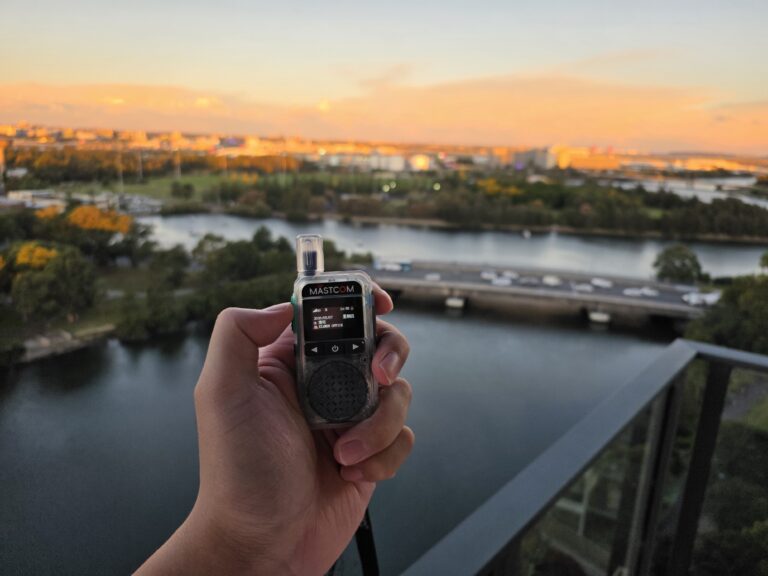
Field users simply operate their MASTCOM S3 Portable Radios as they normally would.
The DM960 receives transmissions from the handheld radios and retransmits them using the same RF frequency through TDMA timeslot separation, effectively extending communication coverage across the operating area.
This architecture offers several practical benefits:
- Extended communication range
- Improved indoor signal penetration
- Better communication reliability
- Minimal infrastructure requirements
- Fast deployment with lower overall costs
For many small and medium-sized radio systems, this configuration provides an ideal balance between performance, flexibility, and investment.
(Insert MASTCOM SFR Topology Diagram Here)
A Real-World Example
Imagine a logistics warehouse covering approximately 18,000 square meters.
Workers at the loading docks can communicate clearly with the dispatch office, but communication becomes unreliable inside the high-density storage aisles due to steel shelving and building structure.
Instead of installing a conventional repeater system requiring additional frequency resources, the customer deploys a DM960 configured in SFR mode with an external antenna positioned above the warehouse office.
Warehouse staff continue using S3 portable radios without changing their daily operating procedures.
The result is improved coverage across the warehouse while keeping deployment simple and avoiding the cost and complexity of a traditional repeater installation.
For many businesses, this type of deployment provides exactly the level of coverage they need.
Option 4 – Expand Your Communication System Gradually
In many projects, communication requirements grow over time.
A company may begin with direct radio communication, introduce an SFR solution as operations expand, and later integrate dispatch software or nationwide PoC communication when additional functionality is required.
This phased approach allows organizations to improve communication step by step without replacing existing equipment.
It also protects previous investments while keeping the system flexible for future expansion.
When Is a Traditional Repeater Still the Better Choice?
Although SFR is an excellent solution for many applications, conventional repeater systems remain the preferred choice in some situations.
A traditional repeater is generally more suitable when:
- Coverage is required across multiple buildings or campuses
- High voice traffic capacity is expected
- Wide-area regional coverage is required
- Wide-area linked repeater systems are planned
- Multiple communication channels need to operate simultaneously
The right solution depends on the operating environment, traffic requirements, and long-term communication strategy rather than simply selecting the most powerful equipment.
Looking Ahead
Many organizations today are looking for ways to improve radio coverage without increasing system complexity or infrastructure costs.
Single Frequency Repeater technology has become a practical option for many commercial and industrial DMR systems by delivering additional coverage while making efficient use of available spectrum.
Alongside the current DM960 SFR solution, MASTCOM is also developing a dedicated next-generation SFR product, expected to be introduced in the second half of 2026.
The upcoming platform is designed to provide:
- Greater deployment flexibility
- Optimized RF performance
- Simplified installation and configuration
- Enhanced coverage capabilities
- More options for professional communication networks
More information will be released as the product approaches launch.
Conclusion
Improving two-way radio coverage doesn't always require building a large repeater network.
By understanding the causes of coverage loss, optimizing antenna placement, selecting equipment that matches the operating environment, and deploying technologies like Single Frequency Repeater where appropriate, organizations can significantly improve communication performance while keeping infrastructure costs under control.
For many commercial and industrial applications, combining the MASTCOM DM960 as an SFR node with MASTCOM S3 Portable Radios provides a reliable, scalable, and cost-effective communication solution.
It's a practical approach that extends coverage, simplifies deployment, and delivers dependable communication with less infrastructure and lower deployment costs.
About MASTCOM
MASTCOM is a global communication brand specializing in professional radio communication solutions for commercial, industrial, and mission-critical applications.
Backed by nearly three decades of manufacturing expertise, MASTCOM provides DMR radios, PoC devices, analog radios, and communication systems designed for security, construction, logistics, hospitality, manufacturing, and public safety.
Whether you're building a new communication network or upgrading an existing one, MASTCOM delivers reliable solutions that keep teams connected and operations running efficiently.