
Introduction
Coverage is one of the most common challenges in two-way radio systems.
A team may have reliable communication around a warehouse, construction site, hotel, or industrial facility, but once users move behind concrete structures, into underground areas, or to the far side of a large site, signal strength can quickly become an issue.
The traditional solution is to install a repeater. While effective, conventional repeaters require a pair of frequencies, additional RF components, and more complex frequency planning.
For many organizations, especially those operating with limited frequency resources, that isn't always the most practical option.
This is where Single Frequency Repeater (SFR) technology comes in.
SFR allows a DMR radio system to extend communication coverage using a single RF frequency. It reduces spectrum requirements, simplifies deployment, and offers a cost-effective alternative for many commercial and industrial applications.
In this article, we'll look at how SFR works, where it is commonly used, and how organizations can deploy an efficient SFR network using MASTCOM communication solutions.
What Is a Single Frequency Repeater (SFR)?
A Single Frequency Repeater (SFR) is a DMR feature that enables both the repeater and subscriber radios to operate on the same RF frequency.
Unlike a conventional repeater that uses separate frequencies for transmitting and receiving, an SFR system utilizes TDMA (Time Division Multiple Access) technology to separate inbound and outbound traffic through different timeslots.
In simple terms, the repeater receives a signal on one timeslot and retransmits it on the other. To the user, communication works much like a traditional repeater system, but only one frequency channel is required.
This makes SFR particularly useful in regions where frequency resources are limited or where obtaining additional licensed channels can be difficult.
How SFR Differs from a Traditional Repeater
To better understand the benefits of SFR, it's helpful to compare it with a conventional repeater system.
Traditional Repeater
A conventional repeater typically:
- Receives on one frequency
- Transmits on another frequency
- Requires a duplexer
- Uses a paired frequency allocation
- Involves more frequency planning and licensing requirements
Single Frequency Repeater (SFR)
An SFR system:
- Operates on a single RF frequency
- Uses TDMA timeslots to separate receive and transmit traffic
- Eliminates the need for a frequency pair
- Simplifies deployment
- Makes more efficient use of available spectrum
For many small and medium-sized radio networks, SFR offers a practical balance between coverage improvement and deployment simplicity.
Why SFR Is Becoming More Popular
Radio spectrum is becoming increasingly crowded, especially in urban and industrial environments.
For many businesses, obtaining an additional frequency pair can be costly, time-consuming, or simply unavailable.
SFR addresses these challenges by making better use of existing spectrum resources.
Reduced Frequency Requirements
Only one RF frequency is required, simplifying licensing and frequency planning.
This can be a significant advantage in areas where available channels are limited.
Faster Deployment
Because there is no requirement for a transmit/receive frequency pair, SFR systems can often be deployed more quickly than traditional repeater solutions.
This is especially useful for temporary projects and rapidly changing work environments.
Lower Infrastructure Costs
For many applications, SFR can improve communication coverage without the expense of building a dedicated repeater network.
Organizations can achieve better coverage while keeping equipment and installation costs under control.
Flexible Coverage Expansion
SFR works particularly well when communication needs to be extended quickly across a worksite, facility, or event location without major infrastructure changes.
Typical Applications of SFR
Construction Sites
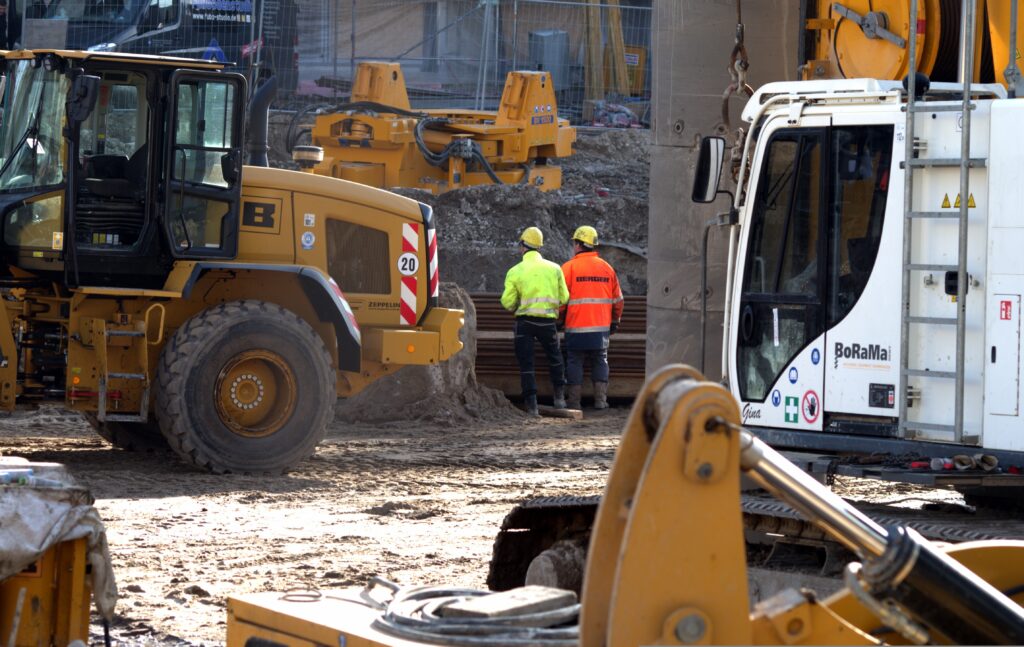
Construction environments change constantly.
Steel structures, temporary buildings, machinery, and varying terrain can all affect radio performance.
An SFR deployment helps maintain communication between project managers, supervisors, operators, and security personnel across the site.
Warehousing and Logistics

Large warehouses often contain dense storage racks, metal shelving, and loading areas that can create communication dead zones.
SFR can improve coverage between warehouse teams, dispatch operators, and vehicle fleets working across the facility.
Security Operations

Security personnel frequently operate across multiple buildings, parking areas, and outdoor perimeters.
SFR provides an efficient way to extend communication coverage without requiring a full repeater infrastructure.
Hospitality and Facilities Management

Hotels, resorts, commercial buildings, and large venues rely on seamless communication between departments.
Housekeeping, engineering, maintenance, and security teams can all benefit from improved radio coverage throughout the property.
Emergency Response and Temporary Command Posts
When communication systems need to be established quickly, SFR offers a practical solution.
Emergency response teams, event organizers, and temporary operations can deploy coverage enhancement with minimal infrastructure requirements.
A Typical MASTCOM SFR Deployment
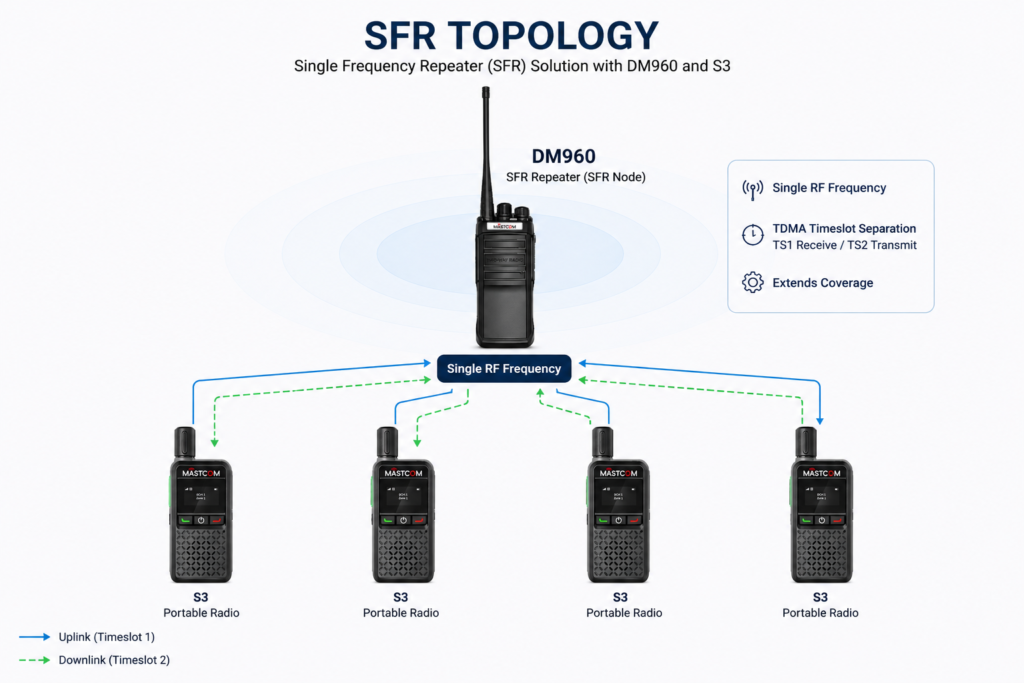
For organizations looking to deploy SFR technology, a common approach is to use the MASTCOM DM960 Mobile Radio as the SFR node and MASTCOM S3 Portable Radios as field terminals.
DM960 as the SFR Node
In a typical deployment, the DM960 is configured to operate in SFR mode and positioned at a location that provides optimal coverage.
Common installation points include:
- Site offices
- Security control rooms
- Dispatch centers
- Mobile command vehicles
- Elevated positions within a facility
By receiving and retransmitting communications through SFR, the DM960 can help extend radio coverage beyond normal direct-mode operating range.
Key advantages include:
- DMR digital communication
- Single Frequency Repeater functionality
- Flexible fixed or mobile installation
- Reliable operation for temporary and permanent deployments
- Cost-effective coverage enhancement
Learn more about the MASTCOM DM960 Mobile Radio.
S3 as the Field Terminal
Working alongside the DM960, the MASTCOM S3 Portable Radio serves as the communication tool for frontline personnel.
Compact, reliable, and easy to operate, the S3 is suitable for a wide range of industries, including:
- Security
- Construction
- Logistics
- Hospitality
- Facility management
Key benefits include:
- Lightweight and portable design
- Clear digital voice communication
- Long battery life
- Easy deployment and operation
- Seamless compatibility with SFR networks
With the DM960 acting as the SFR coverage point and S3 radios used by field personnel, organizations can build a reliable communication system without the complexity of a traditional repeater network.
Learn more about the MASTCOM S3 Portable Radio.
SFR vs Traditional Repeater Systems
| Feature | SFR Solution | Traditional Repeater |
|---|---|---|
| Frequency Requirement | Single Frequency | Frequency Pair |
| Spectrum Efficiency | High | Moderate |
| Deployment Speed | Fast | Slower |
| Infrastructure Complexity | Low | Higher |
| Installation Cost | Lower | Higher |
| Temporary Deployment | Excellent | Moderate |
| Coverage Expansion | Good | Excellent |
| Frequency Licensing Requirement | Lower | Higher |
For many commercial and industrial users, SFR provides an effective balance between coverage improvement, deployment flexibility, and overall cost.
Looking Ahead: The Next Generation of MASTCOM SFR Solutions
As communication requirements continue to evolve, MASTCOM is expanding its SFR portfolio beyond mobile-radio-based deployments.
Building on the proven capabilities of the DM960 SFR solution, MASTCOM is currently developing a dedicated next-generation SFR product scheduled for release in the second half of 2026.
The upcoming solution is expected to deliver:
- Greater deployment flexibility
- Optimized RF performance
- Simplified installation and configuration
- Enhanced coverage capabilities
- More application possibilities for professional users
More details will be announced in the coming months.
Conclusion
Single Frequency Repeater technology offers a practical way to extend DMR radio coverage while minimizing frequency requirements and infrastructure costs.
For organizations operating in construction, logistics, security, hospitality, industrial, and temporary deployment environments, SFR can be an effective alternative to traditional repeater systems.
By combining the DM960 Mobile Radio as an SFR node with S3 Portable Radios for field personnel, organizations can build a reliable communication network that is easy to deploy, cost-effective, and scalable.
As demand for flexible communication solutions continues to grow, SFR technology will play an increasingly important role in helping teams stay connected and operate more efficiently.
About MASTCOM
MASTCOM is a global communication brand focused on delivering professional radio communication solutions for commercial, industrial, and mission-critical applications. Backed by nearly three decades of manufacturing expertise, MASTCOM offers DMR radios, PoC solutions, analog radios, and communication systems designed to keep teams connected in demanding environments.
From daily operations to large-scale deployments, MASTCOM is committed to helping organizations master every connection.